Shipping from China to the United States is the world's most active trade lane. American businesses rely on it for consumer goods, electronics, furniture, apparel, and machinery, with China accounting for close to $430 billion in annual U.S. import value. But getting goods across the Pacific has never been straightforward — and 2026 has added a new layer of complexity that has caught many importers off guard.
Tariff policy has shifted repeatedly. The de minimis exemption for low-value Chinese shipments has been eliminated. U.S. Customs and Border Protection has launched aggressive new enforcement campaigns targeting Chinese-origin cargo. If you are still working from a shipping cost model built before 2025, it needs updating. This guide walks you through the entire process — from choosing a shipping method to selecting a freight forwarder who won't let you down — with the 2026 landscape in mind.
1. Why Shipping from China to the U.S. Is Harder Than Ever in 2026
Before you book anything, you need to understand what has changed. Three forces have reshaped the China-U.S. shipping lane over the past 18 months.
The de minimis exemption is gone. For more than two decades, shipments valued under $800 entered the U.S. duty-free with minimal paperwork. As of 2025, that exemption was terminated for Chinese-origin goods. As of February 2026, the suspension was extended to all countries through executive order, and postal shipments can no longer use the "per-item fixed duty" method that many small sellers relied on. Every shipment, regardless of value, now requires full HTS classification and duty payment based on product category.
Customs enforcement has intensified dramatically. In early 2026, CBP established a Fast Document Review team and launched a specialized inspection campaign targeting Chinese-origin cargo. In just two months, 3,826 Chinese containers were flagged for enhanced inspection, with 3,137 forced to return — a rejection rate of 82%. The agency also moved to invalidate thousands of Importer of Record numbers held by non-resident or virtual importers, requiring that the IOR be a real, verifiable entity with a genuine U.S. presence.
Tariff stacking makes landed cost calculation essential. Chinese goods now face a combination of base duty rates, Section 301 tariffs (25% or 7.5% depending on the product), and other applicable surcharges. A qualified customs broker or forwarder should be able to provide you with a detailed landed cost breakdown before your cargo ever leaves China.
The practical takeaway: this is no longer a lane where you can cut corners on compliance. The importers who succeed in 2026 are the ones who treat customs and documentation as a core part of their supply chain, not an afterthought.
2. Choosing Your Shipping Method: Ocean, Air, or Express
Your first major decision is how your cargo will cross the Pacific. The right choice depends on three variables: volume, urgency, and budget.
Ocean Freight: The Workhorse
Ocean freight moves the vast majority of commercial cargo between China and the U.S. It splits into two options:
FCL (Full Container Load) gives your cargo an entire 20-foot or 40-foot container, sealed from origin to destination. It is the better choice for shipments above roughly 12–15 CBM. FCL offers lower cost per unit, faster transit (no consolidation delays), and reduced handling risk. Current benchmarks for 2026 show a 20ft container from Shanghai to Los Angeles running approximately $2,000–$3,500 on the spot market, with 40ft containers at $3,500–$8,000.
LCL (Less-than-Container Load) consolidates your cargo with other shippers' goods in a shared container. You pay only for the space you occupy, which makes it cost-effective for smaller volumes. The trade-off is longer transit times due to consolidation and deconsolidation handling at each end, and a higher risk that another shipper's documentation issue delays the whole container. LCL rates run approximately $80–$180 per CBM to the West Coast.
Transit times for ocean freight are typically 18–25 days to the West Coast and 30–40 days to the East Coast.
Air Freight: When Speed Justifies the Cost
Air freight is the right choice when speed matters more than cost per kilogram. Standard air freight from China typically arrives within 3–7 days port-to-port, with door-to-door service adding a few days on either end. Air freight costs roughly $4.50–$8.00 per kilogram in 2026, making it five to eight times more expensive per kilogram than ocean freight. It makes sense for high-value goods, urgent restocks, and product launches where being out of stock costs more than the air premium.
Express Courier: Door-to-Door Convenience
Services like DHL, FedEx, and UPS handle parcels and small shipments up to roughly 300 kg with 2–4 day delivery. Express is the most expensive per kilogram but requires the least coordination on your end — the courier handles pickup, export clearance, transport, import clearance, and final delivery. It is best suited for time-critical small parcels and samples.
A quick decision framework: If your shipment exceeds 12–15 CBM and timing is flexible, go FCL. If you have a smaller volume and want to test a new product, LCL makes sense. If you are out of stock on a bestseller and need goods in under a week, pay the air freight premium. If you are shipping a few boxes of samples, use express.
3. The Entire Shipping Process, Step by Step
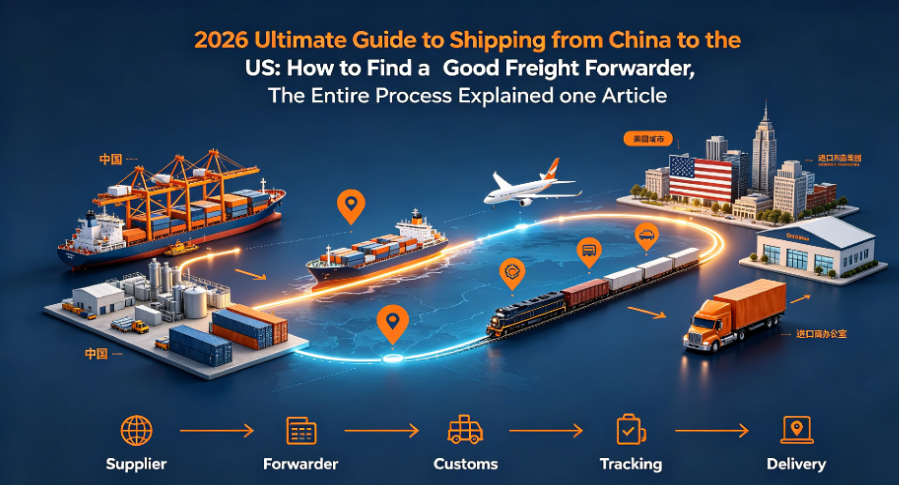
Here is what actually happens between your supplier's factory in China and your warehouse or fulfillment center in the U.S.
Step 1: Confirm your Incoterms and who controls the freight. The biggest mistake new importers make is letting their supplier arrange shipping. When your supplier books the freight, you lose visibility, you lose cost transparency, and you have little recourse if something goes wrong. The standard recommendation for importers who want control is FOB (Free On Board), which means your supplier handles export clearance and delivery to the Chinese port, while you nominate your own freight forwarder for the ocean or air leg.
Step 2: Book with your forwarder and prepare documentation. Your forwarder will book space with the carrier and coordinate pickup from your supplier. You will need to provide or confirm: a commercial invoice with accurate HTS codes, a packing list, and the bill of lading instructions. For ocean freight, the Importer Security Filing (ISF, also known as "10+2") must be filed with CBP at least 24 hours before the vessel loads. This is not optional, and late filing triggers automatic penalties.
Step 3: Export clearance in China and departure. Your forwarder or their agent handles export declaration with Chinese customs. Once cleared, the cargo is loaded onto the vessel or aircraft.
Step 4: Transit across the Pacific. Ocean transit takes 18–25 days to the West Coast and 30–40 days to the East Coast. Air transit takes 3–7 days. During this window, your forwarder should provide tracking updates and flag any issues.
Step 5: U.S. customs clearance. Before your cargo arrives, a licensed customs broker files the entry documentation with CBP. For shipments valued at $2,500 or more, formal entry is required, which involves a customs bond, a detailed entry summary, and duty payment. Your broker will also confirm whether any Partner Government Agency requirements apply — FDA for food and cosmetics, FCC for electronics, CPSC for children's products, and so on.
Step 6: Duty payment and release. Once CBP reviews and accepts the entry, duties and fees are paid, and the cargo is released. If your shipment was flagged for inspection (which is more likely than ever for Chinese-origin cargo), this step can add days or weeks.
Step 7: Final delivery. Your forwarder arranges trucking from the port to your final destination — whether that is your own warehouse, a 3PL, or an Amazon fulfillment center. For FBA shipments, the forwarder must coordinate delivery appointments with Amazon's receiving system, and the cargo must arrive with correct FBA labels and packaging, as Amazon discontinued its U.S. FBA prep and labeling services as of January 1, 2026.
4. How to Find a Good Freight Forwarder
This is where most importers either save themselves a lot of pain or create a lot of it. A good freight forwarder does not just book cargo — they manage compliance, anticipate problems, and communicate proactively. A bad one disappears when things go wrong.
First, understand what a freight forwarder actually does
A freight forwarder organizes shipments and assumes responsibility for the transportation of goods from origin to destination. Unlike a freight broker, which simply connects shippers with carriers, a forwarder handles the physical freight, customs documentation, and often warehousing and final delivery. For China-to-U.S. shipping, your forwarder should be able to manage: pickup from your supplier, export clearance, ocean or air booking, ISF filing, U.S. customs clearance (often through a partner customs broker), duty payment, and final delivery.
What to look for
FMC and NVOCC credentials. If your forwarder is handling ocean freight to the U.S., they should hold a Federal Maritime Commission license or operate as a licensed NVOCC. You can verify FMC numbers through the FMC's public database. Many legitimate China-based forwarders also hold China Class-A freight forwarding licenses and NVOCC credentials from China's Ministry of Transport.
A real U.S. presence. Given the 2026 IOR enforcement changes, it is more important than ever that your forwarder has a genuine U.S. entity or partnership that can serve as or support your Importer of Record. Ask directly: Who will be the IOR on my shipment? Can you provide a U.S. business address and a named contact who answers during U.S. business hours?
Lane-specific experience. A forwarder who is excellent on the China-Europe lane may have little depth on China-U.S. Ask how much volume they handle on your specific route, which carriers they work with, and what their average transit times have been over the past six months. Schedule reliability on Asia-U.S. lanes hovers around 60% on-time performance, so a forwarder with strong carrier relationships and realistic transit expectations is worth more than one who quotes the lowest rate.
Transparent, itemized pricing. A legitimate quote should break down ocean or air freight, origin charges, destination charges, customs brokerage, ISF filing, and any applicable surcharges. If a forwarder quotes you a single "all-in" number without itemization, ask for the breakdown. If they cannot or will not provide it, walk away. The most common pricing trap in this lane is the "zero freight" or suspiciously low quote that recovers margin through hidden destination charges.
Responsive communication in your time zone. This sounds basic, but it is one of the most common complaints from U.S. importers. A forwarder who only responds during Chinese business hours creates a 12-hour communication gap that can turn a manageable problem into a crisis. Ask for their escalation process and test their response time during the quoting phase.
References from U.S. clients. Ask for two or three current U.S. customers you can contact directly — not testimonials the forwarder provides on their website. A forwarder who cannot or will not connect you with real references is a red flag.
Red flags to avoid
A quote that is dramatically lower than every other quote you receive is almost never a good sign. Common warning signs include:
No verifiable physical office address
Only mobile phone contact numbers with no fixed landline
Payment requests to personal accounts or via Western Union
Vague or evasive answers about customs clearance procedures
Poor English communication combined with a refusal to provide written documentation
A practical verification checklist
Before you commit to a forwarder, run through this:
Verify their business license through China's national credit information system.
Confirm their FMC or NVOCC number if they are handling ocean freight.
Ask for their customs broker's license number on the U.S. side.
Request a written quote with a full cost breakdown.
Run a small trial shipment before committing your main volume.
Purchase cargo insurance — not from the forwarder's in-house affiliate unless you have verified that the underwriter is legitimate, but from a third-party insurer you trust.
5. The Three Mistakes That Cost Importers the Most Money
Mistake 1: Letting your supplier control the freight. When your supplier books shipping, they often use a forwarder who serves the supplier's interests, not yours. You get less visibility, less control, and little recourse when delays occur. Take control of your own freight — it is one of the highest-leverage decisions you can make as an importer.
Mistake 2: Ignoring landed cost until the cargo arrives. Duties, tariffs, customs brokerage fees, and destination charges can add 30–50% or more to your product cost. If you have not calculated landed cost before you place your purchase order, you are flying blind. Ask your forwarder for a landed cost estimate that includes all applicable tariffs and fees before you commit to a shipment.
Mistake 3: Treating customs compliance as someone else's problem. With CBP's 2026 enforcement posture, a misclassified HTS code or an improperly filed ISF can result in your entire container being held or returned. Your forwarder can help, but the legal responsibility for accurate classification and valuation rests with the importer of record — which is you.
The Bottom Line
Shipping from China to the U.S. in 2026 is more complex than it was two years ago, but it is not unmanageable. The importers who do it well share three habits: they control their own freight, they work with a forwarder they have verified and tested, and they treat customs compliance as a core business function rather than a cost to minimize.
Start by getting quotes from at least three forwarders with verifiable credentials. Ask for itemized pricing and references. Run a trial shipment before scaling. And build a direct relationship with a customs broker who can explain the tariff situation for your specific products.
The Pacific is wide, but it is crossable. The difference between a smooth supply chain and a costly mess usually comes down to the partner you choose on the other side.
Homitt | Shipping Agent China
Homitt is a professional China-based freight forwarder dedicated to providing reliable end-to-end international shipping solutions for global importers, Amazon FBA sellers and cross-border merchants. Headquartered in Shenzhen, we leverage China’s major ports including Shenzhen, Guangzhou, Shanghai, Ningbo and Xiamen to deliver stable ocean freight, air freight, LCL consolidation, FBA head shipment, customs brokerage, warehousing and door-to-door DDP services worldwide.
With years of practical experience in cross-border logistics, our operation team is familiar with the shipping rules of Europe, USA, UK, Australia, Southeast Asia and the Middle East. We handle cargo from factory pickup, inspection, consolidation, customs declaration to overseas destination delivery. Whether you are shipping small batch samples, LCL parcels or full container FCL shipments, Homitt can tailor a cost-effective logistics plan matching your lead time and budget.
Countries served by DDP dedicated sea/air freight lines:
USA, Canada, UK, Germany, Belgium, Luxembourg, Netherlands, Czech Republic, France, Poland, Croatia, Slovenia, Slovakia, Denmark, Finland, Italy, Monaco, Austria, Sweden, Bulgaria, Estonia, Latvia, Lithuania, Hungary, Greece, Portugal, Spain, Romania, Australia, UAE, Saudi Arabia, Kuwait, Qatar, Bahrain, Oman, Singapore, Malaysia, Thailand, Philippines, Indonesia, Hawaii, Alaska, Puerto Rico, Russia, Belarus, Ukraine, Kyrgyzstan, Kazakhstan.
We build long-term partnerships with shipping lines and airlines, which helps us secure competitive space and stable rates even in peak seasons. Transparent tracking, proactive risk notification and one dedicated account manager for each client are our core commitments. Unlike ordinary freight brokers, Homitt focuses on solving real supply chain pain points: customs clearance delays, cargo damage, unstable transit time and hidden charges.
Our vision is simple: to be your trusted shipping agent from China, simplify global trade and let your goods move safely and smoothly across borders.