If you import from China, you've probably dealt with the frustration of a shipment stuck in customs, a supplier who won't confirm pickup details, or a freight quote that somehow doubles by the time the invoice arrives.
A good shipping agent in China solves most of that. A bad one makes it worse.
This guide walks through how to find, vet, and actually work with a China-based shipping agent — without the trial-and-error that eats into your margins.
What a China Shipping Agent Actually Does
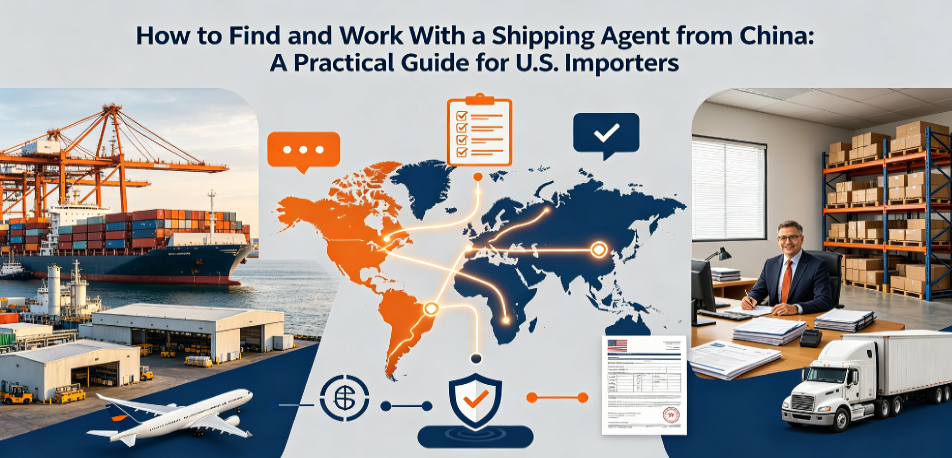
A shipping agent is your on-the-ground representative inside China's logistics system. They sit between your factory and the port, handling the tasks that are nearly impossible to manage from overseas: communicating with suppliers in Chinese, arranging inland trucking, filing export customs declarations, and booking space with ocean or air carriers.
They're not the ship or the airline. They're the coordinator who makes sure your cargo actually moves from the factory floor to the vessel — and that the paperwork is right before it gets there.
For U.S. importers, this matters because China's export regulations are dense and frequently updated. A competent agent acts as a compliance buffer, catching issues before they become port holds.
Why You Can't Just "Book Online" and Hope for the Best
The China freight forwarding market is massive — valued at roughly $14.7 billion in 2025 and projected to reach nearly $26 billion by 2035. That scale means thousands of agents, ranging from excellent to outright fraudulent.
The most common problems U.S. buyers report:
Hidden fees that appear after the cargo is already on the water
Customs delays caused by incorrect HS codes or missing documentation
Ghosting when something goes wrong and the agent stops responding
None of these are hypothetical. They're the reason due diligence matters more than the lowest quote on the table.
Step 1: Know Exactly What You Need Before You Start Looking
Most agent-selection mistakes happen because the importer hasn't defined the shipment clearly. Before you contact anyone, write down:
Cargo type and volume — full container (FCL), less-than-container (LCL), air freight, or rail
Origin and destination — which Chinese port or city, and which U.S. port or inland warehouse
Service scope — do you need just port-to-port, or door-to-door including U.S. customs clearance?
Special requirements — Amazon FBA prep, DDP terms, product inspection, or repackaging
Agents specialize. Someone who excels at LCL consolidation out of Shenzhen may have zero experience with oversized machinery from Qingdao. The more specific you are upfront, the faster you'll filter out mismatches.
Step 2: Where to Actually Find Candidates
There are four reliable channels:
1. Supplier referrals.
Your Chinese manufacturer has shipped goods before. Ask which forwarder they've worked with and whether they'd recommend them. This is often the fastest path to a known quantity.
2. Freight directories.
The China International Freight Forwarders Association (CIFA) lists over 700 licensed members. FIATA's global directory is another starting point.
3. Trade platforms.
Alibaba and similar B2B platforms list forwarders with verified profiles, transaction histories, and response-time metrics. These data points aren't perfect, but they're better than cold outreach.
4. Industry networks.
If you're in an e-commerce or sourcing community, ask who others are using. A referral from someone shipping similar goods carries more weight than any directory listing.
Step 3: Vet Before You Talk Price
This is where most importers get burned. A low quote means nothing if the agent can't legally handle your shipment.
Ask for these four documents before discussing rates:
Chinese business registration. This confirms the company is a legitimate registered entity, not a one-person operation working out of a WeChat account.
NVOCC or freight forwarding license. In China, agents handling ocean freight need proper licensing. If they can't produce it, walk away.
Insurance certificate. Cargo insurance protects you if goods are damaged or lost in transit. Confirm the agent either carries their own liability coverage or can arrange coverage for your shipment.
References from U.S. clients. Ask for two or three importers they've worked with recently. Then actually contact them. Ask about communication responsiveness, how they handled problems, and whether the final invoice matched the quote.
Red flag alert: A reliable agent should provide all of this without hesitation. Reluctance to share documentation is a warning sign you shouldn't ignore.
Step 4: Evaluate on Performance, Not Promises
Once you have a shortlist, compare them on operational metrics:
On-time delivery rate. Below 95% suggests systemic issues. Top performers consistently exceed 98%.
Response time. If they take more than 24 hours to answer a pre-sale question, expect the same — or worse — when your cargo is stuck.
Communication language. If your team works in English, confirm the agent has bilingual staff who can communicate clearly with both you and your Chinese supplier.
Service scope. Can they handle pickup from the factory, inspection, consolidation, and Amazon FBA labeling? Or only port-to-port?
A practical test: send a specific scenario question. For example, "If my supplier delays pickup by three days, what's the process and what costs apply?" How they answer tells you more than any brochure.
Step 5: Start With One Shipment, Then Scale
Don't sign a long-term contract for your first shipment. Book one container or one air shipment and watch how the process unfolds:
Did the agent confirm pickup details with the supplier directly?
Was the export documentation prepared correctly the first time?
Did you receive tracking updates without having to ask?
Did the final invoice match the quote?
If the answer is yes across the board, you've found a partner worth scaling with. If not, you've learned what you needed at minimal cost.
A vetted agent like Homitt — shipping agent China fits this model: licensed, bilingual, experienced with U.S. import requirements, and structured to handle both LCL consolidation and FCL door-to-door. For U.S. importers who want origin-side control without managing five different vendors, that's the profile to look for.
The Bottom Line
Finding a shipping agent from China isn't complicated — it's just detail-oriented. Define your shipment, use referrals and directories to build a shortlist, verify licenses and references, and test with one shipment before committing.
The importers who get this right aren't the ones who find the cheapest rate. They're the ones who find an agent that communicates clearly, documents properly, and shows up when something goes wrong.
That's the partner worth keeping.