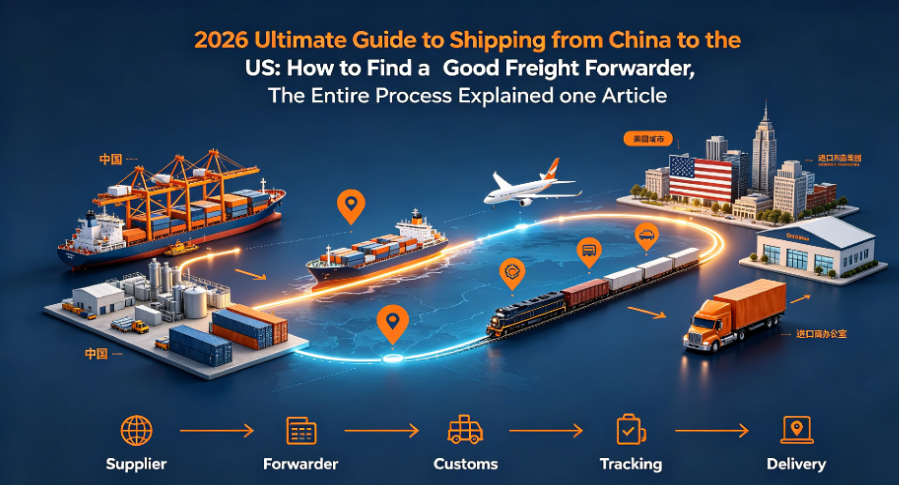
Updated for 2026 tariff rules, de minimis changes, and CBP enforcement. Written for U.S. importers, Amazon FBA sellers, and small-business buyers.
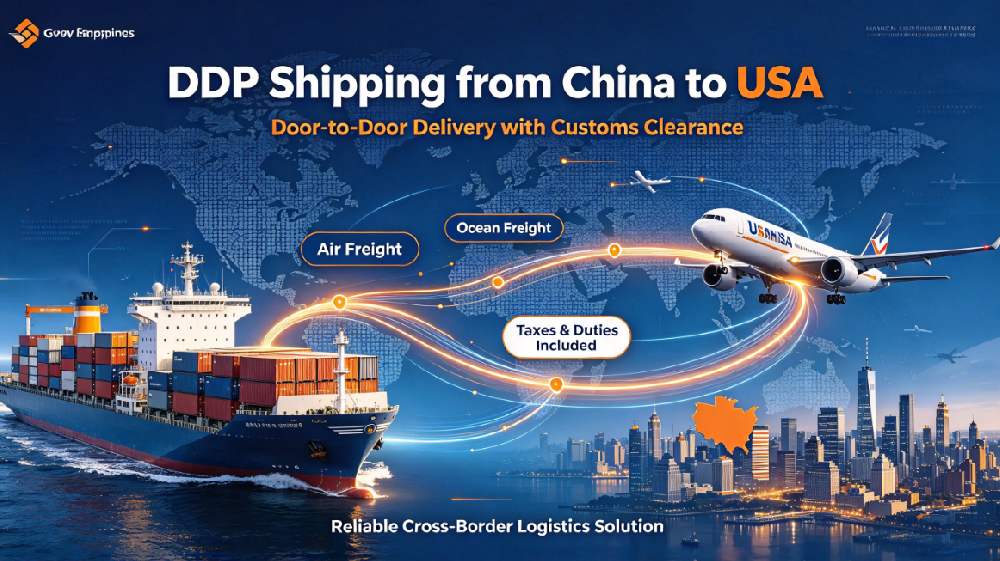
If you import from China, you already know the hard part isn't finding a supplier. It's getting your goods from a factory floor in Shenzhen, Ningbo, or Guangzhou to a warehouse in Los Angeles, a fulfillment center in Memphis, or a customer's doorstep in Dallas — without customs surprises, hidden fees, or a container stuck at port racking up demurrage while you wait for a document you didn't know you needed.
That's where DDP shipping comes in. Delivered Duty Paid (DDP) is an Incoterm that puts virtually every cost and risk on the seller's side of the table: freight, export clearance, import customs, duties, taxes, and final delivery. You pay one price. You get your goods at your door. Nothing left to settle.
For many U.S. importers — especially e-commerce sellers, Amazon FBA vendors, and small-to-mid-size B2B buyers — DDP is the simplest path to importing from China. But simple doesn't mean risk-free. In 2026, the DDP landscape has changed dramatically, and understanding what you're actually paying for is more important than ever.
Table of Contents
1. What Is DDP Shipping, Exactly?
DDP stands for Delivered Duty Paid. It's one of eleven standardized international commercial terms — Incoterms — published by the International Chamber of Commerce. Under a DDP arrangement, the seller (or the freight forwarder acting on the seller's behalf) is responsible for everything until the cargo reaches the buyer's named destination.
That "everything" is a longer list than most first-time importers realize:
Picking up goods from the supplier's factory or warehouse in China
Inland trucking to the port or airport of departure
Export customs clearance and export documentation in China
Terminal handling, loading, and origin charges
International freight — air, ocean, rail, or express courier
Import customs clearance in the United States
Paying all applicable duties, tariffs, and customs fees
U.S. port/airport handling and drayage
Final-mile delivery to your specified address
As the buyer, your only real responsibilities are unloading at the destination and accepting delivery. Everything else is handled upstream.
Key point: This is fundamentally different from FOB or EXW terms, where you (the buyer) become the Importer of Record the moment cargo leaves the factory or port. With FOB, you're managing the ISF filing, the customs bond, the HTS classification, the duty payment, and the drayage — or you're paying a broker to do it. DDP collapses all of that into a single line item on your invoice.
Who Is the Importer of Record Under DDP?
This is the single most important question in any DDP conversation, and it's the one most importers never ask.
In a legitimate DDP arrangement, the forwarder (or a designated entity they control) acts as the Importer of Record (IOR). They file the customs entry in their own name, they post the customs bond, they pay the duties out of their own account, and they bill you a single all-in price that already includes those costs.
In a problematic DDP arrangement, the forwarder uses a shell company as the IOR — a disposable entity with no real assets, no real presence, and no intention of surviving a CBP audit. When enforcement comes, that entity vanishes, and the liability trail leads back to you.
Rule of thumb: If your forwarder can't or won't tell you — in writing — exactly which legal entity is acting as the Importer of Record on your shipment, treat that as a red flag.
2. DDP vs. Every Other Incoterm (Full Comparison)
Most importers only ever encounter four or five Incoterms in practice. Here's how they stack up against each other, from the buyer's perspective.
| Incoterm | Who Pays Freight | Who Clears Import | Who Pays Duties | Buyer Risk Level |
|---|---|---|---|---|
| EXW (Ex Works) | Buyer | Buyer | Buyer | Highest |
| FCA (Free Carrier) | Buyer | Buyer | Buyer | High |
| FOB (Free on Board) | Buyer (after loading) | Buyer | Buyer | High |
| CIF (Cost, Insurance, Freight) | Seller (to U.S. port) | Buyer | Buyer | Medium |
| DAP (Delivered at Place) | Seller | Buyer | Buyer | Medium |
| DDP (Delivered Duty Paid) | Seller | Seller | Seller | Lowest |
The Trade-Off Nobody Mentions
DDP gives you the least risk and the least control. That's the honest trade-off. When a forwarder handles customs on your behalf under DDP:
You usually don't see the customs entry summary (CBP Form 7501) unless you ask for it
You often don't know the declared value the forwarder submitted
You may not know which HTS code was used to classify your goods
You have limited visibility into how much of your payment went to duties versus freight
For a first-time importer, that opacity is worth the convenience. For an importer doing $500K+ per year, it becomes a real problem — because you are still the ultimate beneficiary of the goods, and CBP can come back to you if the entry was fraudulent.
Best practice: Even under DDP, ask your forwarder to send you the CBP 7501 entry summary and the commercial invoice they declared on your behalf. A legitimate forwarder will provide these without hesitation. One that refuses is telling you something.
3. DDP vs. DDU / DAP: What's the Difference?
The closest alternatives to DDP are DDU (Delivered Duty Unpaid) and DAP (Delivered at Place). The key difference is simple: with DDU/DAP, the buyer pays duties and taxes upon arrival. With DDP, the seller pays them upfront and includes them in the quoted price.
| Factor | DDP (Delivered Duty Paid) | DDU / DAP |
|---|---|---|
| Who pays duties & taxes | Seller / Forwarder (included in price) | Buyer (billed upon arrival) |
| Who is Importer of Record | Seller or forwarder's designated entity | Buyer |
| Upfront cost visibility | High — one all-in price | Lower initial cost, duties hit later |
| Risk of surprise bills | Low for the buyer | High — customs invoice at delivery |
| Customs bond required from buyer | No | Yes |
| HTS classification control | Forwarder | Buyer |
| Best for | E-commerce, FBA sellers, first-time importers, high-volume shipping | Experienced importers, low-value or non-urgent goods, buyers who want customs control |
Most e-commerce businesses and Amazon sellers choose DDP because it removes friction at checkout and at delivery. The customer gets exactly what they expect — no surprise customs bills, no held packages, no awkward phone calls asking why there's an extra $47 owed before delivery.
DDU still has its place. For low-value shipments where duties are minimal, or for importers who already have a customs broker and a continuous customs bond in place, DDU can be more cost-effective. But for the vast majority of U.S. importers shipping commercial volumes from China, DDP is the default choice.
4. 2026 Cost Breakdown: What DDP Actually Costs
DDP pricing varies significantly based on your shipment's weight, volume, HS code, origin city in China, destination in the U.S., and the freight method you choose. Here are realistic 2026 planning benchmarks for the freight and delivery portion of a DDP quote — before duties and U.S. entry fees, which are covered separately below.
Air Freight (DDP)
| Chargeable Weight | Planning Range | Typical Door-to-Door Time |
|---|---|---|
| 45–100 kg | $6–$8 per kg | 5–10 days |
| 100–300 kg | $5–$7 per kg | 5–10 days |
| 300–500 kg | $4.50–$6 per kg | 5–10 days |
| 500+ kg | $4–$5.50 per kg | 5–10 days |
Ocean LCL (Less-than-Container Load)
| Volume | Planning Range | Typical Door-to-Door Time |
|---|---|---|
| 1–3 CBM | $130–$150 per CBM | 20–55 days |
| 3–8 CBM | $115–$135 per CBM | 20–55 days |
| 8–15 CBM | $100–$120 per CBM | 20–55 days |
Ocean FCL (Full Container Load)
| Container Size | Planning Range | Typical Door-to-Door Time |
|---|---|---|
| 20ft (≈28 CBM) | $2,800–$5,500 | 20–55 days |
| 40ft (≈58 CBM) | $3,500–$7,000 | 20–55 days |
| 40HC (≈68 CBM) | $3,800–$8,000 | 20–55 days |
Express Courier (DDP)
| Shipment Size | Planning Range | Typical Door-to-Door Time |
|---|---|---|
| 10–100 kg | $8–$15 per kg | 3–7 days |
Important caveat: A DDP quote that comes in significantly below these ranges is almost certainly excluding something — duties, customs brokerage, or final-mile delivery. Always ask a forwarder what is not included in their quoted number before comparing it to anything else.
What's Usually Inside a DDP Quote vs. Outside It
| Cost Item | Typically Included | Sometimes Excluded |
|---|---|---|
| Factory pickup in China | ✔ Yes | — |
| China export clearance | ✔ Yes | — |
| International freight | ✔ Yes | — |
| U.S. customs clearance | ✔ Yes | — |
| Import duties & tariffs | Usually | Often excluded — verify |
| Merchandise Processing Fee (MPF) | Usually | Sometimes excluded |
| Harbor Maintenance Fee (HMF) | Usually | Sometimes excluded |
| Final-mile delivery | Usually | Excluded for remote areas / liftgate / inside delivery |
| Demurrage / detention | No | Almost always excluded |
| FDA / FCC / EPA filing | No | Excluded — often a big surprise |
| Storage after free time expires | No | Excluded |
That last row matters more than people expect. If your product touches the FDA (food, supplements, cosmetics, medical devices), the FCC (electronics with radio transmitters), the EPA (engines, certain chemicals), or the CPSC (children's products, toys), your goods may require additional filings, registrations, or prior notice — none of which are typically covered by a standard DDP quote. Ask about this before you book.
5. Duties, Tariffs, and U.S. Entry Fees in 2026
The biggest misconception about DDP shipping from China is that the quoted price is the total cost. In reality, the "all-in" DDP price is only all-in if it includes duties and U.S. entry fees — and in 2026, those line items are larger than most importers expect.
Import Duties: There Is No Single "China Rate"
Duty rates depend entirely on your product's Harmonized Tariff Schedule (HTS) code. There is no flat "China duty rate." A cotton T-shirt, a lithium battery, and a machined aluminum bracket all carry different base rates.
On top of the base Most Favored Nation (MFN) rate, most China-origin goods also carry additional Section 301 tariffs, which were introduced in 2018 and have been revised multiple times since. The rate depends on the specific HTS subheading and the List your product falls under.
2026 reality check: Because tariff rates and executive actions have changed repeatedly over the past several years, any specific percentage you read online — including in this article — should be verified against the current HTSUS and the latest CBP guidance before you commit to a landed cost. Ask your forwarder or a licensed customs broker for a written duty estimate tied to your specific HTS code.
U.S. Entry Fees: Two Line Items Most Quotes Gloss Over
Every formal customs entry triggers two mandatory fees:
| Fee | How It's Calculated | Who It Applies To |
|---|---|---|
| Merchandise Processing Fee (MPF) | Ad valorem percentage of entered value, subject to a minimum and a maximum cap per entry. Informal entries under $2,500 pay a small flat fee instead. | Almost all formal entries |
| Harbor Maintenance Fee (HMF) | 0.125% of cargo value | Ocean freight arriving at a U.S. port only — air freight does not trigger HMF |
These fees are small individually, but they add up across multiple shipments — and they're frequently the reason a DDP quote "looks cheap" until the forwarder sends a supplemental invoice.
The De Minimis Shock — and What It Means for DDP
For years, the $800 de minimis exemption meant that most small shipments from China entered the U.S. duty-free. That era is over.
De minimis treatment for China-origin goods was terminated in May 2025, and subsequent executive action extended the suspension of de minimis treatment more broadly. The practical result: every package now requires full HTS classification and duty payment, regardless of value.
What does that mean in dollar terms? A product that previously entered duty-free at a $50 declared value may now face meaningful combined tariff and fee exposure. Multiply that across thousands of small parcels, and the economics of low-value direct-to-consumer importing change completely.
For DDP importers, this has a counterintuitive effect: DDP is now more valuable, not less. When duties were zero, DDP's main benefit was convenience. Now that duties are a real line item on every shipment, DDP's benefit is predictability — you know your landed cost before you pay your supplier, instead of discovering it when the invoice arrives.
A Note on Anti-Dumping and Countervailing Duties (AD/CVD)
Some product categories — solar panels, certain steel and aluminum products, aluminum foil, hardwood plywood, and many others — are subject to anti-dumping (AD) and countervailing duty (CVD) orders. These can add triple-digit percentages to your landed cost, and they are strictly enforced.
Critical warning: If your product is subject to an AD/CVD order, be extremely careful with any DDP quote that "includes duties" but doesn't ask you about AD/CVD. Legitimate DDP pricing for AD/CVD goods requires the importer of record to post cash deposits — and a forwarder who quotes a flat low price for AD/CVD merchandise is either eating a massive loss or doing something illegal.
6. The DDP Shipping Process, Step by Step
Understanding how DDP actually works on the ground helps you spot problems before they become expensive. Here's the full operational flow from a U.S. buyer's perspective.
Step 1: Quote and Booking
You provide the forwarder with cargo details: product description, HS code (if known), gross weight, dimensions, number of cartons, cargo value, supplier address in China, and delivery address in the U.S. The forwarder returns a DDP rate. Get it in writing, and get the inclusions/exclusions spelled out.
Step 2: Cargo Pickup in China
Your supplier either delivers goods to a consolidation warehouse or the forwarder arranges pickup from the factory. Cargo quantity, packaging integrity, and shipping marks are verified against the packing list before anything moves.
Step 3: Booking and Export Clearance
The forwarder books space with a carrier — COSCO, Evergreen, OOCL, ZIM, or ONE for ocean; or an air carrier for freight. China export customs declaration is filed, and export release is obtained before loading begins.
Step 4: Documentation Assembly
The critical document set is assembled: Shipping Order, House Bill of Lading (HBL), Master Bill of Lading (MBL), Commercial Invoice, Packing List, and Certificate of Origin. Under DDP, the forwarder typically acts as the Importer of Record on the U.S. side, which means they are filing the entry paperwork — not you.
Step 5: International Transit
Ocean freight moves through the chosen port pair (e.g., Shenzhen–Los Angeles, Shanghai–New York). Air freight moves through major hubs. Transit time is the longest variable in the DDP timeline: ocean LCL can take 20–55 days door-to-door; air freight runs 5–10 days.
Step 6: U.S. Customs Clearance and Duty Payment
This is the step that makes DDP DDP. The forwarder files the customs entry, pays the duties and MPF/HMF fees, and clears the cargo through CBP. You do nothing. No customs bond application, no ISF filing, no HTS classification decisions. That's the value proposition.
Under DDP, the forwarder is also responsible for filing the Importer Security Filing (ISF, "10+2") at least 24 hours before vessel loading. If they miss that window, expect a $5,000+ penalty — and under a well-structured DDP contract, that's their problem, not yours.
Step 7: Drayage and Final-Mile Delivery
Once cleared, cargo is drayed from the port or airport to the final destination — whether that's an Amazon FBA fulfillment center, a commercial warehouse, or a residential address. Under a true DDP arrangement, this is included in the quoted price.
Step 8: Proof of Delivery and Documentation Handoff
You receive a POD (proof of delivery). Ask for the CBP 7501 entry summary and the declared commercial invoice at this point. Keep them on file. If CBP ever questions your entries, these documents are your defense.
7. Transit Times by Route and Mode
Transit time is the single most misunderstood element of DDP shipping. The number your forwarder quotes you is usually port-to-port sailing time — not door-to-door. Here's the realistic breakdown.
| Route | Mode | Port-to-Port | Door-to-Door |
|---|---|---|---|
| Shenzhen / Yantian → Los Angeles | Ocean | 14–22 days | 22–35 days |
| Shenzhen / Yantian → New York | Ocean | 25–35 days | 33–48 days |
| Shanghai / Ningbo → Los Angeles | Ocean | 15–24 days | 23–37 days |
| Shanghai / Ningbo → Savannah | Ocean | 28–38 days | 36–52 days |
| Any major China hub → Any U.S. airport | Air | 2–4 days | 5–10 days |
| Door-to-door parcel | Express | — | 3–7 days |
Where the extra 8–15 days come from: origin consolidation and loading (2–5 days), export clearance (1–2 days), vessel waiting at anchor or blank sailing delays (0–10 days), U.S. customs clearance and CBP holds (1–5 days, longer for exams), drayage appointment availability (1–7 days at congested ports), and final-mile scheduling (1–3 days).
Planning advice: If your forwarder quotes you a door-to-door DDP time that matches the port-to-port sailing time, they're not being honest with you. Always add buffer for a realistic production and shipping calendar — especially for Q4 peak season (August–November), when space is tight and port congestion is worst.
8. Documents You Need (and Who Handles Them)
One of DDP's real advantages is that most of the paperwork burden shifts to the forwarder. But you should still know what exists, because you'll need copies for your own records, accounting, and — if things go wrong — your defense.
| Document | Purpose | Who Prepares It |
|---|---|---|
| Commercial Invoice | Declares value, product description, quantity, buyer/seller | Supplier |
| Packing List | Details carton count, weights, dimensions, marks | Supplier |
| Bill of Lading (HBL/MBL) | Contract of carriage; title document for ocean freight | Carrier / Forwarder |
| Air Waybill (AWB) | Contract of carriage for air freight (non-negotiable) | Airline / Forwarder |
| ISF Filing (10+2) | Required 24h before vessel loading for ocean freight | Forwarder / Broker |
| Entry Summary (CBP Form 7501) | The official record of your customs entry, HTS codes, and duty paid | Licensed Customs Broker |
| Certificate of Origin | Confirms country of manufacture (China) | Supplier / Chamber of Commerce |
| Product Certificates (FCC, CE, FDA, CPSIA) | Required for regulated categories | Supplier / Testing Lab |
Non-negotiable: Ask for the CBP Form 7501 after every DDP shipment clears. It shows exactly what HTS code was used, what value was declared, and how much duty was paid. If your forwarder can't produce it, that's a serious problem — because it means you have no idea whether your entries were filed correctly.
9. The Big Risk in 2026: Not All DDP Is Legitimate
Here's the part most DDP marketing pages won't tell you: U.S. Customs and Border Protection has spent the past several years building an enforcement infrastructure specifically designed to catch the schemes that kept many DDP prices artificially low. And in 2026, that enforcement is in full swing.
The tactics CBP is targeting include:
Understating commercial value on invoices to reduce dutiable value
Misclassifying products under HTS codes that carry lower tariff rates
Using shell companies as fake importers of record to hide the real party liable for duties
Splitting shipments to stay under thresholds or avoid quota limits
Transshipping through third countries to disguise Chinese origin
These aren't gray-area compliance lapses. They are customs fraud. When CBP uncovers fraud, it demands unpaid duties, penalties, and interest — and forwarders who built their entire pricing model on evasion tend to become insolvent almost immediately.
What Happens to You If Your Forwarder Was Cutting Corners
The damage to importers is severe and lasting:
Expanded audits covering years of prior entries. CBP's statute of limitations for fraud cases extends well beyond the standard window.
Retroactive duty liability. If customs values were systematically understated, the back-duty bill can be substantial — and it lands on the beneficiary of the goods.
Penalties and interest. CBP penalties for fraud can reach multiples of the lost revenue.
A compliance record that follows you. Once flagged, every future shipment you move gets extra scrutiny — for an indeterminate amount of time.
No recovery path. If the forwarder was structured as a shell company with no real assets, there is virtually no legal avenue to recover the duties you paid. The money is gone, the operator has disappeared, and you're left holding the compliance liability.
How to Protect Yourself
Work with a forwarder who uses a licensed U.S. customs broker. A qualified broker ensures accurate declarations, correct values, proper tariff payment, and a legitimate importer of record. A good broker also identifies red flags before cargo ever moves.
Ask who is acting as the Importer of Record. If the answer is vague, or if the forwarder refuses to name the entity, walk away. You need to know whose name is on the customs entry.
Be skeptical of prices that seem too low. If a DDP quote is 30–40% below the market, something is being cut — and it's usually compliance.
Get your own customs bond if you ship regularly. Even under DDP, having your own continuous customs bond gives you a safety net and a direct relationship with CBP that doesn't depend on a third party's solvency.
Request the 7501 after every shipment. Review the HTS codes and declared values. If they don't match what you're actually importing, ask why — in writing.
Put the compliance responsibility in the contract. Your DDP agreement should state explicitly that the forwarder is responsible for accurate classification, valuation, and duty payment — and that they indemnify you for penalties arising from their errors.
10. How to Choose a DDP Shipping Agent
The quality of your shipping agent determines whether DDP is a competitive advantage or a slow-motion liability. Here's the due diligence checklist that separates serious operators from the ones you'll regret.
| What to Verify | Why It Matters |
|---|---|
| Licensed U.S. customs broker on staff or under contract | Only a licensed broker can legally file entries on your behalf and advise on classification |
| Named Importer of Record entity | You need to know who is legally responsible for the entry |
| Written DDP quote with inclusions/exclusions | Prevents the "supplemental invoice" surprise |
| Real, verifiable business address and track record | Shell companies disappear when enforcement arrives |
| Transparent HTS classification methodology | Misclassification is the #1 source of retroactive duty liability |
| Ability to provide CBP Form 7501 post-clearance | Proof they actually filed what they said they filed |
| Experience with your product category | Regulated goods (FDA, FCC, EPA) require specialized knowledge |
| Multiple carrier relationships | Single-carrier forwarders can't route around congestion or blank sailings |
| Warehousing / consolidation capability in China | Lets you combine multiple suppliers into one shipment and cut costs |
| Cargo insurance options | Carrier liability is limited — often far below your cargo's actual value |
| Responsive communication across time zones | A 12-hour email delay during a customs hold costs real money |
Red flags to walk away from: no physical address, no named customs broker, prices 30%+ below market, refusal to provide the 7501, pressure to under-declare value "to save you money," or a quote that changes after the cargo has already shipped.
11. Why Importers Work with Homitt
Homitt — shipping agent China — was built around a simple observation: most importers don't need a cheaper DDP quote. They need a DDP quote they can actually trust.
Homitt is a China-based shipping agent specializing in DDP shipping from China to the USA, along with DDU, FOB, and door-to-door logistics across air, ocean, and express channels. The company works with U.S. importers ranging from first-time Amazon FBA sellers to established e-commerce brands moving multiple containers a month.
What Sets Homitt Apart
| Capability | What It Means for You |
|---|---|
| Transparent, all-in DDP pricing | Your quote spells out what's included — freight, clearance, duties, and final-mile delivery — so there are no supplemental invoices after the fact. |
| Licensed U.S. customs broker network | Entries are filed properly, with accurate HTS classification and declared values. You get the 7501 on request. |
| China-side consolidation warehousing | Buy from multiple suppliers and have everything consolidated into one shipment — a major cost saver for sellers sourcing from several factories. |
| Multi-modal options: air, ocean FCL/LCL, express | You get routed to the mode that actually fits your timeline and budget, not the one that makes the forwarder the most money. |
| Amazon FBA delivery expertise | Direct delivery to FBA fulfillment centers, with attention to Amazon's appointment, labeling, and packaging requirements. |
| Regulated-goods experience | Support for product categories that touch FDA, FCC, EPA, or CPSC requirements — where a generic DDP quote will leave you exposed. |
| Bilingual support across time zones | Communication with your Chinese suppliers in their language and with your U.S. team in yours — no information lost in translation. |
| Shipment visibility and updates | Proactive status updates at each milestone, rather than you chasing a tracking number that hasn't moved in nine days. |
Services Offered by Homitt
DDP shipping from China to the USA — air, ocean LCL, and ocean FCL
DDU / DAP shipping for importers who prefer to control their own customs entry
FOB and EXW logistics for experienced importers with their own broker and bond
Amazon FBA inbound shipping to U.S. fulfillment centers
Supplier consolidation — multiple factories, one shipment
Cargo insurance coordination
Customs documentation support including HTS classification guidance and 7501 retrieval
Last-mile delivery to commercial warehouses, 3PLs, and residential addresses
Who Homitt Works With
Homitt's U.S. client base spans the full spectrum of importers:
Amazon FBA and Walmart WFS sellers shipping inventory directly to fulfillment centers
Shopify and DTC e-commerce brands restocking their own 3PL or warehouse
Small and mid-size B2B importers sourcing components, raw materials, or finished goods
First-time importers who want the customs burden handled end-to-end
Growing brands transitioning from air freight to ocean consolidation as volume scales
Get a DDP quote from Homitt: Send your product details, HS code (or product description), gross weight, carton dimensions and count, supplier address in China, and U.S. delivery address. Homitt will return a written DDP rate with clear inclusions and exclusions — so you can compare quotes on the same basis instead of guessing what's inside the number.
12. Which Freight Mode Should You Choose?
| Mode | Best For | Cost Range | Door-to-Door Time |
|---|---|---|---|
| Express Courier | Urgent samples, high-value small parcels, product launches | $8–$15/kg | 3–7 days |
| Air Freight | Medium-volume shipments, time-sensitive restocks, electronics | $4–$8/kg | 5–10 days |
| Ocean LCL | Small-to-medium volumes, non-urgent goods, furniture, apparel | $100–$150/CBM | 20–55 days |
| Ocean FCL | Full container volumes, heavy goods, best per-unit cost at scale | $2,800–$8,000/container | 20–55 days |
The Decision Rule, Simplified
Under 100 kg and time-sensitive? → Express or air freight.
Over 2 CBM and you can wait 3–5 weeks? → Ocean LCL.
Consistently moving more than 15 CBM? → Negotiate FCL rates. The per-unit economics are dramatically better.
Launching a new product and testing demand? → Air freight the first batch, then move to ocean once the product proves out.
Product is heavy and low-value per unit? → Ocean, always. Air freight will destroy your margin.
Chargeable weight matters: Air freight and express couriers bill on volumetric weight, not just actual weight. The standard formula is (L × W × H in cm) ÷ 6000 for air, and ÷ 5000 for express. If your product is bulky but light — think pillows, large plastic items, or packaging-heavy goods — you'll pay for the space, not the weight. This catches many first-time importers off guard.
13. DDP Shipping for Amazon FBA Sellers
DDP is the most common shipping arrangement among Amazon FBA sellers for good reason: it's the only way to get inventory from a Chinese factory to an Amazon fulfillment center without opening a customs bond, hiring a broker, and managing the entry yourself.
How FBA DDP Works
You place a purchase order with your Chinese supplier.
Your forwarder arranges pickup, consolidation, and export from China.
The forwarder handles U.S. customs clearance and pays duties.
Cargo is delivered to the FBA fulfillment center you specified in your shipping plan.
Amazon receives, checks in, and makes your inventory available for sale.
FBA-Specific Things That Go Wrong
| Problem | How to Avoid It |
|---|---|
| Missing or wrong FBA labels | Confirm your forwarder knows Amazon's labeling requirements and will inspect labels before shipping |
| Delivery appointment rejections | FBA centers require scheduled appointments; a forwarder without FBA experience will miss these |
| Carton weight/dimension violations | Amazon has strict limits; exceeding them triggers fees or refusal |
| Split shipments to multiple FCs | Amazon may route your shipment to several fulfillment centers — make sure your quote covers this |
| Customs holds tied to Amazon-bound cargo | CBP scrutinizes FBA-bound DDP shipments; accurate classification and valuation is essential |
| Amazon won't protect you from a customs penalty | Your Seller Central account is your responsibility — a fraud finding can follow you |
Bottom line for FBA sellers: DDP is the right choice, but "cheapest DDP quote" is the wrong selection criterion. A forwarder who saves you $300 on freight but gets your entries flagged for under-valuation has cost you far more than $300.
14. 10 Costly DDP Mistakes U.S. Importers Make
Comparing DDP quotes without checking inclusions. A $4.50/kg quote that excludes duties is not cheaper than a $6.50/kg quote that includes them. Always normalize.
Never asking who the Importer of Record is. This is the single most important question in DDP — and the one most importers never ask.
Under-declaring value "to save on duties." This is customs fraud. It also voids most cargo insurance claims, because your insured value won't match your declared value.
Forgetting about regulated-goods filings. FDA, FCC, EPA, and CPSC requirements are not part of a standard DDP quote — and they can stop your shipment cold.
Not buying cargo insurance. Carrier liability is typically limited to a small amount per kilogram. If your cargo is worth $40,000 and the carrier's liability caps at $500, you have a $39,500 problem.
Ignoring the AD/CVD question. If your product is subject to anti-dumping or countervailing duties, a flat DDP quote is a warning sign, not a bargain.
Planning on port-to-port transit times. Door-to-door adds 8–15 days on ocean freight. Build that into your inventory calendar.
Skipping quality inspection before shipping. Once cargo is on the water, fixing a defect problem costs you an entire shipping cycle. Inspect at the factory.
Not getting the 7501. Without it, you have no record of what was declared, what HTS code was used, or what duty was paid. That's a blind spot you can't afford.
Switching forwarders purely on price. The cheapest forwarder is often the one cutting the most corners. Reliability, transparency, and compliance are worth paying for.
15. Restricted and Problematic Goods Under DDP
DDP works smoothly for general merchandise — apparel, home goods, electronics accessories, tools, toys, packaging. It gets complicated fast when your product touches a regulated category.
| Category | Regulator | What's Required |
|---|---|---|
| Food, beverages, supplements | FDA | Prior Notice, facility registration, possibly FSVP compliance |
| Cosmetics & skincare | FDA | MoCRA facility registration, product listing, labeling compliance |
| Electronics with wireless (Bluetooth, Wi-Fi) | FCC | FCC certification or Supplier's Declaration of Conformity |
| Children's products & toys | CPSC | CPSIA testing, Children's Product Certificate |
| Batteries (lithium) | DOT / IATA | UN38.3 test reports, proper hazmat packaging and declarations |
| Medical devices | FDA | 510(k) clearance or registration, depending on class |
| Pesticides, certain chemicals | EPA | EPA registration, TSCA compliance |
| Alcohol, tobacco, firearms | TTB / ATF | Licenses and permits; most forwarders will not handle these under DDP |
| Counterfeit or IP-infringing goods | CBP | Seizure, penalties, potential criminal exposure — never ship these |
Be honest with your forwarder about what you're shipping. If you describe a Bluetooth speaker as "plastic parts" to get a cheaper rate, you're setting yourself up for a customs hold, a reclassification, and a penalty — and your forwarder will have no obligation to absorb the cost.
16. Real-World Cost Example: 300 kg of Goods
Let's put real numbers to this. Scenario: an Amazon FBA seller importing 300 kg of consumer electronics accessories from Shenzhen to a fulfillment center in Ontario, California. Cargo value: $12,000. Volume: 2.5 CBM.
| Option | Freight & Delivery | Estimated Duties & Fees | Total Landed (Est.) | Transit |
|---|---|---|---|---|
| Air DDP | $1,500–$1,800 | Varies by HTS code — verify | Freight + duties | 5–10 days |
| Ocean LCL DDP | $400–$600 | Same duty rate applies | Freight + duties | 25–40 days |
| Express DDP | $2,400–$4,500 | Same duty rate applies | Freight + duties | 3–7 days |
What this illustrates: the freight cost difference between ocean LCL and air freight for a 300 kg shipment is roughly $1,000–$1,200. The transit time difference is roughly 20–30 days. That's the trade-off you're actually making — and it has nothing to do with duties, which apply at the same rate regardless of mode.
Also note: express courier is often the most expensive option per kilogram, even though it feels like the "simple" choice. For anything over 100 kg, air freight almost always beats express on cost.
Get your own numbers: The only way to know your real landed cost is to get a written DDP quote tied to your specific product, HTS code, and destination. Homitt — shipping agent China provides written DDP quotes with clear inclusions and exclusions, so you can compare apples to apples instead of guessing.
17. Frequently Asked Questions
Is DDP legal?
Absolutely. DDP is a standard Incoterm recognized by the International Chamber of Commerce. The arrangement is perfectly legal. The problem is that some forwarders use DDP as a cover for customs fraud — understating values, misclassifying goods, and using shell importers. Legitimate DDP forwarders declare accurate values, pay the correct duties, and use a real importer of record. Ask for proof of their customs broker relationship and their importer of record status.
Can I use DDP for Amazon FBA shipments?
Yes, and many FBA sellers do. DDP is especially popular for FBA because it simplifies inbound logistics: the forwarder handles customs clearance and delivers directly to the fulfillment center. However, Amazon's own compliance requirements are strict, and CBP is paying closer attention to FBA-bound DDP shipments. Make sure your forwarder is using accurate HTS codes and declared values — Amazon will not protect you from a customs penalty.
Do I need a customs bond for DDP?
Technically, no — the forwarder or their designated importer of record carries the bond. But if you import regularly, having your own continuous customs bond is a smart risk-management move. It gives you a direct relationship with CBP and ensures you're not entirely dependent on a third party's compliance practices.
What happens if my DDP shipment gets held by customs?
Under a legitimate DDP arrangement, the forwarder is responsible for resolving the hold — that's what you're paying them for. But "responsible" doesn't always mean "fast." CBP holds can take days or weeks to resolve, and the forwarder's ability to fix the problem depends on how clean their documentation is. If your forwarder was cutting corners, a hold can turn into a months-long nightmare. This is another reason to vet your forwarder carefully before shipping.
Can I switch from DDP to FOB as I grow?
Yes, and many importers do. DDP is an excellent training-wheels arrangement for first-time importers: you learn the logistics flow without the compliance burden. As your volume grows and you build relationships with customs brokers and freight forwarders, moving to FOB or EXW gives you more control over costs and more visibility into the supply chain. But for the first 12–24 months, DDP is often the right call.
How long does DDP shipping from China to the USA take?
It depends entirely on the mode. Express courier: 3–7 days door-to-door. Air freight: 5–10 days. Ocean LCL: 20–55 days. Ocean FCL: 20–55 days. Add buffer during Q4 peak season and Chinese New Year, when factories shut down for 1–3 weeks and space gets tight.
Is DDP more expensive than FOB?
On a line-item basis, yes — the DDP number is higher because it includes duties, clearance, and final delivery that FOB doesn't. But the total landed cost is often similar or even lower under DDP, because a high-volume forwarder gets better rates on freight, brokerage, and drayage than you would buying those services individually. The real value of DDP is predictability, not necessarily the lowest possible price.
What is the minimum shipment size for DDP from China?
Most DDP forwarders handle shipments from as little as 1 CBM or 45 kg for LCL and air freight, and express couriers will take parcels down to a few kilograms. There's no strict minimum, but per-unit costs drop sharply as volume increases.
Does DDP cover cargo insurance?
Usually not automatically. A standard DDP quote covers the cost of moving the cargo, not the cost of losing it. Carrier liability is typically capped at a small amount per kilogram — often far below your cargo's actual value. Ask your forwarder about all-risk cargo insurance as a separate line item. For high-value shipments, it's not optional.
Can DDP be used for products subject to anti-dumping duties?
Technically yes, but with major caveats. AD/CVD merchandise requires the importer of record to post cash deposits at rates that can exceed 100% of the entered value. If a forwarder quotes you a flat, low DDP rate for a product that's subject to an AD/CVD order, be very suspicious. Verify the order status of your HTS code before shipping, and use a forwarder who understands AD/CVD compliance.
What happens if the forwarder's DDP price changes after I've paid?
Legitimate forwarders quote a firm rate with a defined validity window (typically 7–30 days) and honor it. If a forwarder comes back after cargo has shipped demanding more money for "unexpected duties," that's a serious red flag — either they misquoted, or they were never covering duties in the first place. Get your rate in writing, with inclusions listed, before you commit.
How do I know if my forwarder is declaring accurate values?
Request the CBP Form 7501 after the shipment clears. It shows the declared value, HTS code, and duty paid. Compare it against the commercial invoice from your supplier. If the declared value on the 7501 is lower than what you actually paid, you have a problem — and you need to address it immediately.
Does Homitt offer DDP shipping from China to the USA?
Yes. Homitt — shipping agent China provides DDP shipping from China to the USA via air, ocean LCL, and ocean FCL, including customs clearance, duty payment, and final-mile delivery. Homitt also offers DDU, FOB, and EXW arrangements for importers who prefer to manage their own customs entry, plus Amazon FBA inbound shipping, supplier consolidation, and customs documentation support.
18. DDP Glossary for U.S. Importers
| Term | Definition |
|---|---|
| DDP | Delivered Duty Paid — seller handles all costs and risks including duties and taxes to the named destination |
| DDU / DAP | Delivered Duty Unpaid / Delivered at Place — seller delivers to destination, buyer pays duties |
| FOB | Free on Board — seller delivers to the port of departure; buyer arranges freight and import |
| EXW | Ex Works — buyer takes possession at the seller's facility and handles everything from there |
| Importer of Record (IOR) | The entity legally responsible for the customs entry and duty payment |
| HTS Code | Harmonized Tariff Schedule code — determines the duty rate for your product |
| MPF | Merchandise Processing Fee — charged on most formal entries, with a minimum and maximum |
| HMF | Harbor Maintenance Fee — 0.125% of cargo value, ocean freight only |
| ISF (10+2) | Importer Security Filing — required 24 hours before vessel loading for ocean cargo |
| 7501 | CBP Form 7501, the entry summary — the official record of your customs entry |
| Section 301 | Additional U.S. tariffs on certain China-origin goods, applied by HTS subheading |
| AD/CVD | Anti-Dumping / Countervailing Duty — additional duties on specific products from specific countries |
| LCL | Less-than-Container Load — you share a container with other shippers' cargo |
| FCL | Full Container Load — you book an entire container for your cargo |
| CBM | Cubic meter — the standard volume measure for ocean freight pricing |
| Demurrage / Detention | Fees charged when containers sit too long at the port (demurrage) or off-port (detention) |
| Drayage | Short-haul trucking of containers between ports, terminals, and warehouses |
| Chargeable Weight | The greater of actual weight or volumetric weight — the number air/express freight is billed on |
19. Bottom Line
DDP shipping from China to the USA remains the most straightforward way for most American importers to get goods from a Chinese factory to a U.S. door. One price, one provider, no customs surprises — when it's done right.
But 2026 is not 2020. The de minimis era is over. Section 301 tariffs are in full effect. CBP is actively hunting the fraud that made "too good to be true" DDP pricing possible. The importers who thrive in this environment are the ones who understand what DDP actually includes, who demand transparency from their forwarders, and who don't treat compliance as someone else's problem.
If you're shipping from China this year, start by asking the right questions:
Who is the Importer of Record?
What's the declared value methodology?
Who is the licensed customs broker?
What's included in the quote — and what isn't?
Can you send me the CBP 7501 after clearance?
If the answers are clear and verifiable, you're on the right track. If they're not, keep looking.
Ready to Ship DDP from China to the USA?
Homitt is a China-based shipping agent specializing in DDP shipping from China to the USA — air freight, ocean LCL, ocean FCL, and Amazon FBA inbound, with transparent pricing, licensed customs brokerage, and door-to-door delivery.
To get a written DDP quote, send Homitt: your product description, HS code (if known), gross weight, carton dimensions and count, supplier address in China, and U.S. delivery address. You'll get a rate with clear inclusions and exclusions — no guesswork, no surprise invoices.
Disclaimer: This article is provided for general informational purposes and reflects conditions as understood in 2026. Tariff rates, duty treatment, de minimis rules, and CBP enforcement priorities change frequently and may vary based on your specific product, HTS classification, origin, and entry circumstances. Nothing in this article constitutes legal, customs, or tax advice. Always verify current requirements with a licensed U.S. customs broker and consult a qualified trade attorney for compliance-sensitive matters.